
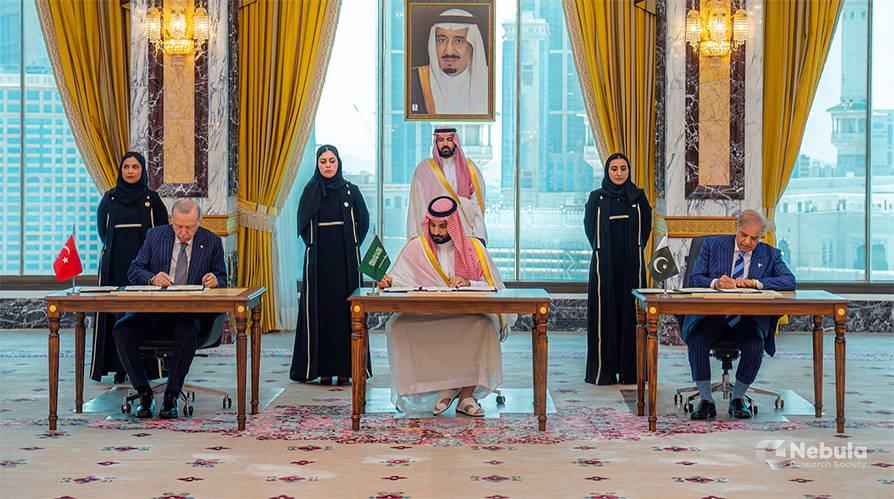
- Signed on August 7, 2026, establishing a binding collective defense treaty where an attack on one is an attack on all.
- Builds directly on the September 17, 2025 Saudi-Pakistan bilateral defense agreement, expanding to include Turkey.
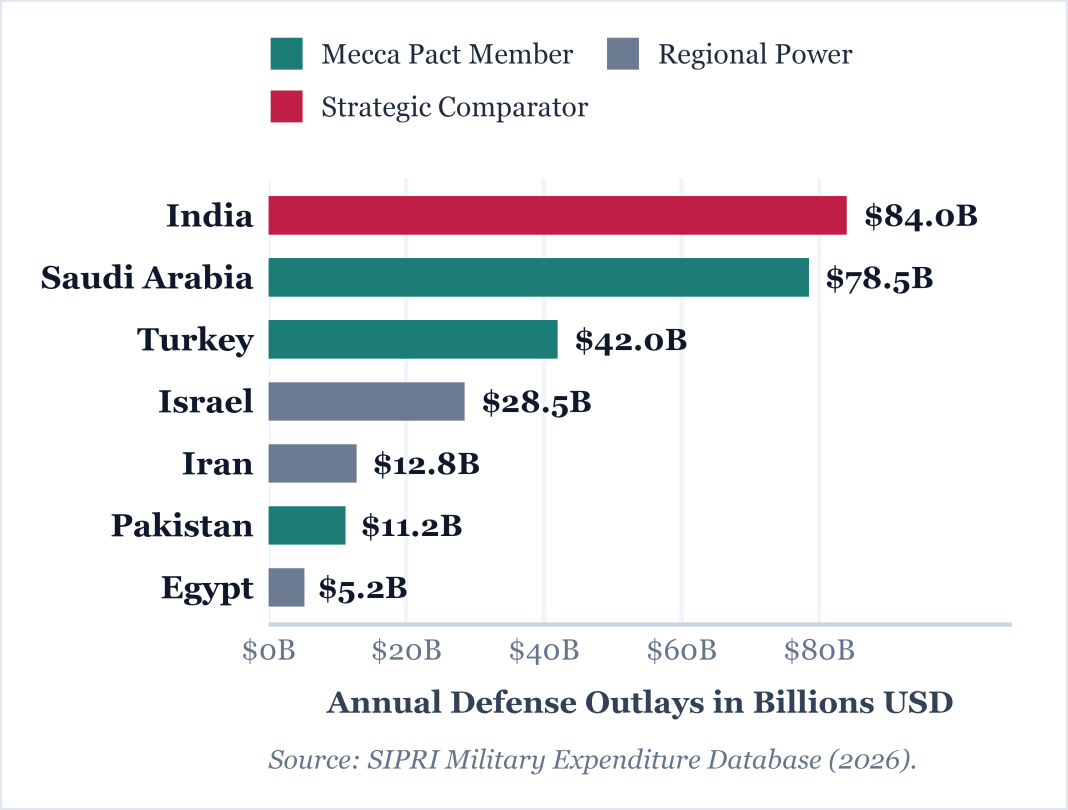
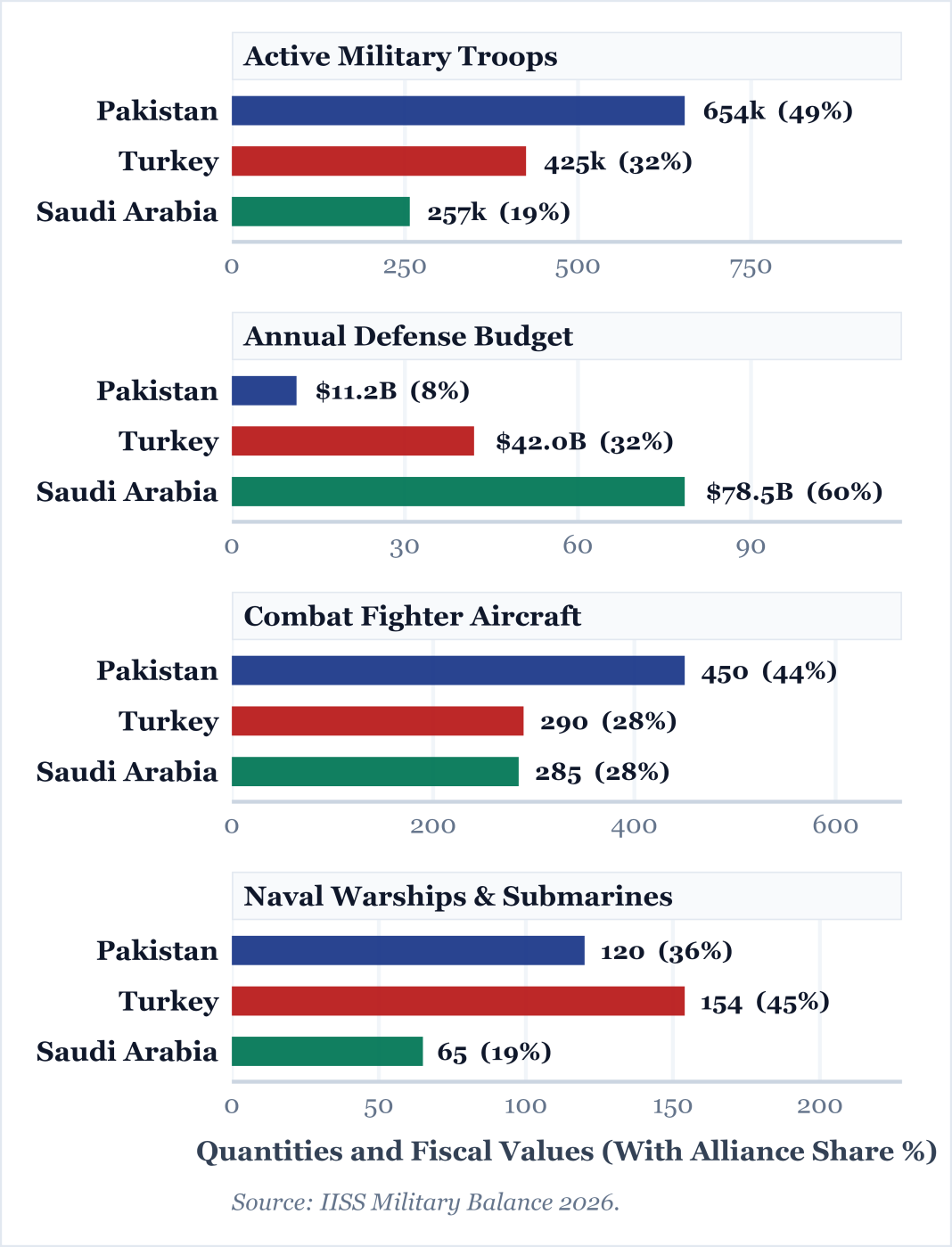
- Unites $131.7 billion in defense spending, 1.336 million troops, 1,025 combat jets, and 339 naval warships.
- Integrates Saudi sovereign funding with Turkish aerospace (KAAN, Bayraktar) and Pakistani missile engineering.
- Leverages Pakistan's nuclear arsenal to cast an implicit extended deterrence umbrella over Riyadh and Ankara.
- On August 27, 2026, Foreign Minister Dr. Khalilur Rahman affirmed Dhaka views the pact positively and will consider joining if invited.
For more than half a century, the security architecture of the Middle East and South Asia rested on external pillars. Western naval armadas secured the energy arteries of the Persian Gulf, advanced American aircraft provided air superiority, and regional defense ministries operated largely as consumers of Western technologies. Yet, the systemic crises spanning 2024 through 2026 shattered the foundational assumptions of that order. As missile and drone salvos repeatedly disrupted commercial shipping through the Red Sea and Gulf of Aden, and as political polarization in Western capitals injected profound uncertainty into long-standing defense commitments, regional middle powers recognized that reliance on distant security guarantees was no longer a viable grand strategy.
On August 7, 2026, Saudi Crown Prince Mohammed bin Salman, Turkish President Recep Tayyip Erdogan, and Pakistani Prime Minister Shehbaz Sharif gathered in the holy city of Mecca. The document they signed was not a ceremonial declaration of goodwill, but a legally binding collective defense treaty: the Mecca Joint Defence Agreement. By merging Saudi financial liquidity, Turkish aerospace innovation, and Pakistani military mass and nuclear deterrence, the three nations created an autonomous security pillar designed to safeguard their sovereignty and project power across the maritime arc from the Mediterranean to the Indian Ocean.
The Diplomatic Genesis from Riyadh to Mecca
The trilateral alliance did not emerge in an institutional vacuum. It represents the structured evolution of bilateral security arrangements established over four decades, accelerated by a decisive diplomatic breakthrough in late 2025.
The historical precedent dates to December 1982, when Riyadh and Islamabad ratified bilateral security protocols that stationed thousands of Pakistani military personnel, flight instructors, and technicians across Saudi bases in Tabuk and Khamis Mushait. While these arrangements fostered deep operational familiarity, they lacked a binding mutual defense clause, as evidenced in 2015 when Pakistan's parliament voted to preserve neutrality during the Yemen conflict. The structural transformation took place on September 17, 2025, when Saudi Defense Minister Prince Khalid bin Salman and Pakistani Chief of Army Staff General Asim Munir signed the Strategic Mutual Defence Agreement (SMDA) in Riyadh. This treaty established a binding legal obligation: an armed attack against Saudi Arabia would be treated as an attack on Pakistan, backed by substantial Saudi economic support and defense venture capitalization.
The bilateral SMDA created the legal and conceptual blueprint for Turkish accession. Between 2023 and 2025, the normalization of Ankara-Riyadh relations aligned Turkey's drive for aerospace export capital with Saudi Vision 2030 localization targets and Pakistan's requirement for fifth-generation combat systems. The August 7, 2026 summit in Mecca successfully elevated these overlapping bilateral interests into a unified trilateral defense pact.
Four Pillars of the Collective Security Treaty
The Mecca Joint Defence Agreement is organized around four core pillars that balance collective deterrence with national operational sovereignty. The first pillar is the mutual collective defense clause, grounded in Article 51 of the United Nations Charter, which stipulates that an armed attack against the sovereign territory, airspace, or vital maritime assets of any signatory constitutes an attack against all three, mandating immediate collective assistance.
The second pillar establishes a Permanent Secretariat in Saudi Arabia, acting as an executive body responsible for continuous crisis monitoring, strategic warning, and organizing bi-annual ministerial councils. The third pillar creates a defense-industrial co-development consortium, mandating technology sharing, joint assembly lines, and supply chain protections to insulate member states from foreign arms embargoes.
The fourth pillar institutes tri-service operational interoperability and an Intelligence Fusion Center in Riyadh. This organ facilitates real-time radar and electronic data exchange, supporting coordinated naval and air patrols across four critical maritime chokepoints: the Strait of Hormuz, the Bab el-Mandeb Strait, the Eastern Mediterranean, and the Northern Arabian Sea.
The Military-Industrial Triad and Defense Economics
The strategic viability of the Mecca Pact rests on the natural complementarity of its members. None of the three nations possessed all the elements required for modern defense autarky, but together they form an integrated military-industrial triad. In aggregate scale, the alliance unites over 1.33 million active-duty military personnel, a combined annual defense expenditure exceeding $131.7 billion, a collective fleet of more than 1,025 combat aircraft, and a naval force comprising 339 major surface combatants and submarines.
Aerospace and industrial co-production forms the operational engine of the alliance. Turkish Aerospace Industries leads the development of the KAAN fifth-generation stealth fighter, supported by Saudi capital injections via SAMI and the Public Investment Fund, alongside software engineering, composite sub-assembly, and flight testing by Pakistan Aeronautical Complex Kamra. Concurrently, Turkey's unmanned combat platforms, including the Bayraktar Akinci and supersonic Kizilelma, are being co-manufactured in Saudi and Pakistani facilities, integrated with Pakistani precision-guided munitions. These programs are backed by Pakistan's solid-fuel ballistic systems, including the Shaheen-III and the multi-warhead Ababeel, providing an indigenous counter-strike capability that complements Saudi Arabia's advanced Patriot and THAAD air defense umbrella.
Calculated Ambiguity and the Question of Strategic Deterrence
International commentators were quick to brand the agreement an Islamic NATO, yet this characterization obscures the treaty's distinct structural reality. Unlike NATO, the Mecca Pact does not establish a supranational command capable of overriding national authorities, nor do its members share contiguous borders. Instead, the alliance operates across three distinct geopolitical arenas: the Aegean and Eastern Mediterranean, the Gulf and Red Sea, and South Asia. Each state also maintains diverse external partnerships, with Turkey anchored in NATO, Pakistan closely tied to China, and Saudi Arabia balancing relationships across Washington, Beijing, and OPEC+ partners.
The nuclear dimension introduces a sophisticated element of strategic ambiguity. Signatory diplomats consistently affirm their adherence to international non-proliferation commitments. Nonetheless, Pakistan's position as the sole nuclear-armed state among the signatories alters regional deterrence calculations. The formalization of a mutual defense pact creates an implicit protective umbrella, obliging any prospective adversary contemplating major military aggression against Riyadh or Ankara to account for the escalatory risk of confronting a nuclear-capable ally.
Diplomatic Repercussions and Regional Rebalancing
On August 27, 2026, Bangladesh officially articulated its perspective on the Mecca Joint Defence Agreement when Foreign Minister Dr. Khalilur Rahman addressed the national parliament and media briefings, declaring that Dhaka views the trilateral pact positively and would give positive consideration to joining should a formal invitation be extended by founding members Saudi Arabia, Turkey, and Pakistan. Characterizing the agreement as a legitimate "self-defense mechanism for the global Muslim community" and an "internal matter of the Muslim family," the Foreign Minister asserted that the alliance is purely defensive and should cause no alarm among neighboring countries or the international community. While noting that substantive deliberations on the specific terms remain premature in the absence of a formal proposal (a stance earlier echoed by State Minister for Foreign Affairs Humaiun Kobir), the government's receptive outlook has sparked a robust domestic and strategic debate over how prospective alignment with the pact might recalibrate Bangladesh's long-standing constitutional foreign policy doctrine of "Friendship to all, malice towards none," balance its delicate bilateral relations with regional neighbor India, and open new avenues for advanced defense-technology transfers and security partnerships with the Gulf and Ankara.
In South Asia, Indian foreign policy planners are assessing the evolving alliance with careful strategic calibration. New Delhi maintains vital economic, crude oil, and diaspora partnerships with Saudi Arabia through the bilateral Strategic Partnership Council, alongside significant regional maritime responsibilities in the Indian Ocean. At the same time, Indian strategists are closely observing the enhancement of Pakistan's defense capabilities through Turkish aerospace transfers and Gulf co-financing. This landscape encourages India to deepen its multifaceted diplomacy across the Gulf while modernizing its own naval and air doctrines to ensure stability across the Arabian Sea.
In the Middle East, the diplomatic trajectory reflects a shared interest in avoiding confrontation. Signatories engaged in constructive backchannel discussions with Tehran to emphasize that the alliance is strictly defensive, aimed at securing vital shipping channels rather than creating a sectarian bloc, thereby preserving the diplomatic de-escalation initiated under the 2023 Beijing agreement. Meanwhile, Israeli defense planners view the integrated aerospace, missile, and financial capabilities of the alliance with serious analytical attention, noting its potential to alter the regional security equilibrium. In the Gulf, the United Arab Emirates continues to pursue an independent bilateral defense strategy, while Egypt remains engaged in diplomatic dialogue as a key partner for Red Sea stability.
For global powers, the Mecca Pact underscores the transition toward a multipolar international system. In Washington, policymakers view the alliance as a complex development: it advances the objective of regional allies shouldering greater defensive responsibilities, yet signals a reduced reliance on unilateral American security guarantees. Beijing welcomes the initiative as an expression of Global South autonomy that protects maritime trade routes, while Moscow views it as consistent with the emergence of a polycentric diplomatic order.
Strategic Trajectories and Future Scenarios
As the Mecca Joint Defence Agreement transitions from ratification to operational execution, its future will be shaped by three prospective trajectories. The first trajectory envisions institutional deepening and regional expansion. Under this path, the Permanent Secretariat achieves full operational readiness, serial production of fifth-generation combat aircraft and advanced drones accelerates, and accession discussions extend to partners such as Bangladesh and Egypt. This would establish a contiguous security corridor spanning the Mediterranean, the Red Sea, and the Bay of Bengal, backed by over $180 billion in combined defense resources.
The second trajectory centers on specialized defense-industrial consolidation. In this scenario, geographical distances and differing theater priorities moderate joint expeditionary deployments, but technological co-development thrives. The alliance succeeds as an independent defense manufacturing powerhouse, shielding its members from Western supply restrictions and establishing indigenous aerospace sovereignty.
The third trajectory involves strategic friction and diplomatic moderation. Diverging regional security imperatives, such as Turkey's focus on the Eastern Mediterranean, Pakistan's focus on South Asia, and Saudi Arabia's focus on the Gulf, could limit the alliance's ability to act as a unified expeditionary force. Under these circumstances, the pact would function primarily as a valuable consultative mechanism and joint training framework rather than an active collective intervention bloc.
The Enduring Legacy of Southern Coalition-Building
The Mecca Joint Defence Agreement is a structural reflection of an increasingly fragmented global order. For middle powers, the post-Cold War model of relying exclusively on Western security guarantees has yielded diminishing returns amid shifting American strategic priorities and volatile maritime crises. By establishing a binding trilateral defense axis, Saudi Arabia, Turkey, and Pakistan are executing a calculated strategy of internal balancing: integrating sovereign capital, aerospace manufacturing, and nuclear-backed deterrence to construct an autonomous zone of security spanning the Eurasian and Indian Ocean corridors.
The true measure of this alliance will not be found in ceremonial summit declarations, but in its resilience when geopolitical crises ignite. Yet regardless of the operational hurdles ahead, the strategic baseline has permanently shifted. In a world where traditional security umbrellas continue to erode, the message from Mecca is unmistakable: regional powers are no longer waiting for external permission to safeguard their own future.


