
Copyright: Nebula Research Society
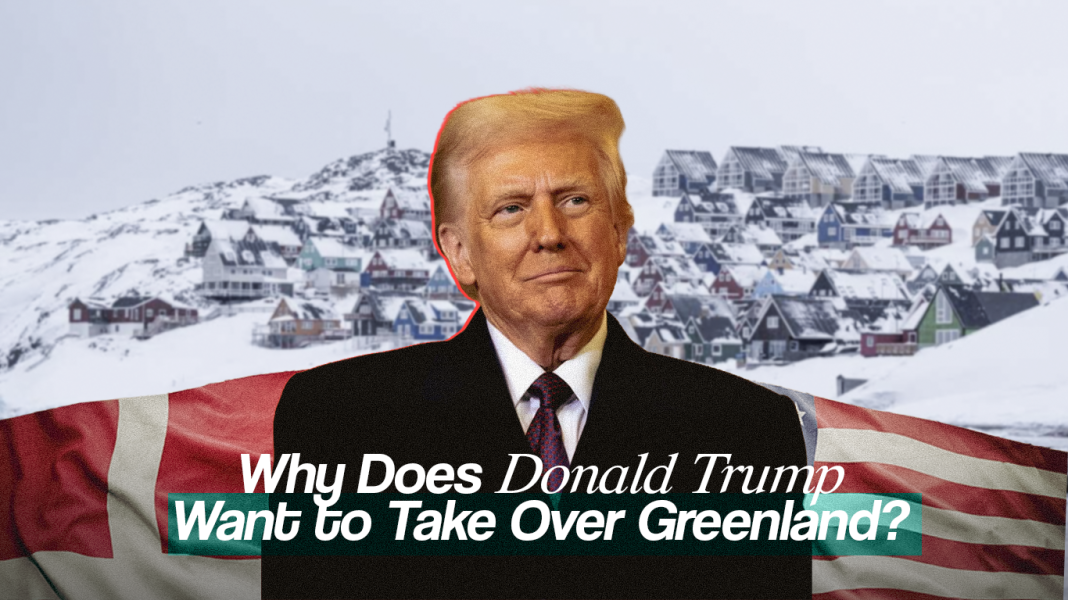
U.S. President Donald Trump wants to take control of Greenland, the world’s largest island—an ambition that has once again shaken global politics. According to Trump,
“We need Greenland for national security.”
Trump first expressed interest in buying Greenland during his initial presidential term in 2019. At the time, many dismissed the idea as a joke. However, after returning to power for a second term in 2025, Trump no longer treats the issue lightly. Instead, he has taken an increasingly aggressive stance on acquiring Greenland. Following the recent removal of Venezuelan President Nicolás Maduro from power, the Greenland debate has resurfaced with renewed intensity.
This time, Trump is not merely talking about purchasing Greenland with money. He has openly suggested the possibility of seizing the island by force if necessary. He has even gone so far as to say that whether Greenlanders like it or not, the United States will “do something” in Greenland. “We are going to do something in Greenland, whether they like it or not.” To understand why Trump is so determined, one must examine Greenland’s history and its immense geopolitical importance.
Historical and Political Status of Greenland
In the early 13th century, Greenland was occupied by Norway. Through agreements between Norway and Denmark, Denmark gradually established control over the island. In 1953, Greenland was formally declared an integral part of the Kingdom of Denmark.
In 1979, Denmark granted Greenland home rule. Later, in a 2008 referendum, Greenlanders voted in favor of greater autonomy, leading to the formation of a self-governing administration in 2009. Although Greenland now has its own prime minister, the Danish King, Frederik X, continues to serve as its head of state.
Trump and Greenland: Old Interest, New Aggression
When Trump first became U.S. president, his 2019 proposal to buy Greenland caused a global stir.
“And I think we’re gonna get it—one way or the other. We’ll keep you safe. We’ll make you rich.”
Denmark’s Prime Minister Mette Frederiksen quickly dismissed the proposal as “absurd.” Denmark’s position was clear: Greenland may be open for business, but it is not for sale.
After returning to office for a second term, Trump revived the proposal with renewed determination. He personally raised the issue in a phone call with Prime Minister Frederiksen. While Denmark remained unwilling to sell Greenland, it agreed to enter discussions under pressure stemming from U.S. military and economic influence.
In early 2026, Trump announced that the use of U.S. military power to acquire Greenland was also under consideration. Denmark responded by warning that any American attack on Greenland would effectively end the NATO alliance. Several European leaders issued a joint statement urging the United States to respect the territorial integrity of Denmark and Greenland.
U.S.–Greenland Relations Before Trump
The idea of Greenland joining the United States did not originate with Trump. Nor was he the first U.S. president to attempt to acquire it. In fact, at one point, Denmark itself encouraged greater U.S. involvement in Greenland.
During World War II, after Nazi Germany occupied Denmark, the Danish ambassador in Washington requested that the United States establish military bases in Greenland to prevent German expansion. More than 10,000 U.S. bomber aircraft landed in Greenland en route to European battlefields.
This experience made Washington realize Greenland’s strategic value for maintaining influence over Europe and Russia. As a result, in 1946, President Harry Truman offered to buy Greenland for $100 million, a proposal Denmark rejected. Shortly afterward, both countries became founding members of NATO.
To ensure NATO’s security, Denmark allowed the United States to establish military bases in Greenland. In 1951, the two countries signed a joint defense agreement, under which U.S. military and later space–bases continue to operate on the island to this day.
Ironically, the country once entrusted with Greenland’s security has now become its greatest perceived threat. Hence the saying, America needs no enemies where it has friends.
The Arctic, Russia, and the GIUK Gap
The United States claims that its urgency regarding Greenland is rooted in national security, specifically the growing threat posed by Russia in the Arctic region. Following the collapse of the Soviet Union, Russia abandoned several Arctic military bases. Over the past decade, however, Moscow has reactivated them, building new airbases, radar stations, missile defense systems, and deploying nuclear submarines along its frozen coastline.
One of the most sensitive areas in this context is the maritime corridor between Greenland, Iceland, and the United Kingdom—known as the GIUK Gap. Russian naval vessels, particularly submarines, use this route to enter the Atlantic Ocean from the Arctic. If control over this corridor weakens, the defense shield between the United States and Europe would be severely compromised, posing a major risk to NATO. Climate change has further intensified competition in the Arctic. Melting ice is opening new shipping routes across the northern hemisphere—routes that are shorter and more efficient than the Suez Canal. China has shown keen interest in using these Arctic routes for trade. Although geographically outside the Arctic Circle, China has declared itself a “near-Arctic state.”
If these routes fall under Russian or Chinese control, a new global trade chokepoint could emerge—one where U.S. influence would be significantly reduced.
Mineral Wealth and Economic Interests
Although Washington frames Greenland primarily as a security concern, economic interests play an equally critical role. If security were the only issue, expanding existing U.S. military and space bases in Greenland would have sufficed. What truly attracts the United States is Greenland’s vast, untapped mineral wealth hidden beneath its ice. In February 2025, a U.S. Senate committee hearing revealed that Greenland is not only strategically important but also economically invaluable. Experts argue that Greenland’s coastline contains one of the world’s largest concentrations of mineral resources, including base metals, industrial stones, and most importantly, rare earth elements. Outside China, the world’s largest rare earth reserves are believed to be in Greenland. However, mining in Greenland is extremely challenging. In 2021, the Greenlandic government suspended certain exploration activities due to the presence of radioactive uranium and environmental risks. High extraction costs have also limited development. As a result, only two mines are currently active on the island, employing roughly 100 people in total.
Whether Donald Trump ultimately succeeds in acquiring Greenland remains uncertain. What is clear, however, is that by reigniting this debate, he has attempted to consolidate his domestic political position, especially as his name has reportedly appeared more than 600 times in the Epstein files related to sexual abuse allegations.


