
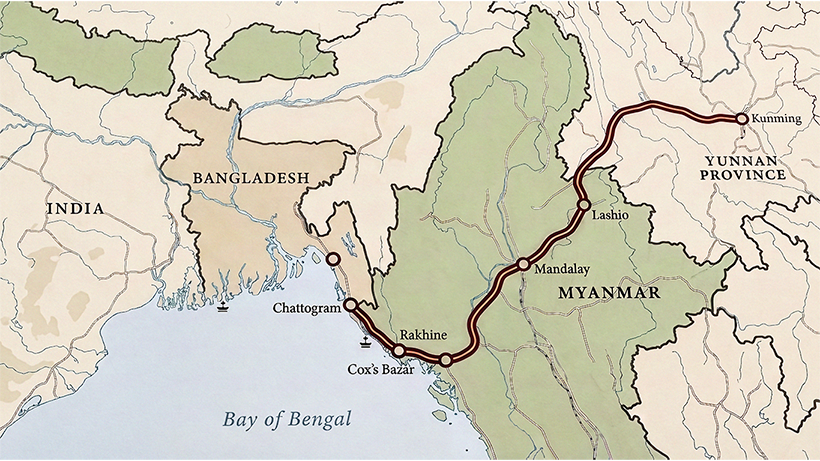
China’s proposal for a Bangladesh-China-Myanmar Economic Corridor was one of the most important outcomes of Prime Minister Tarique Rahman’s meeting with Chinese President Xi Jinping on 26 June 2026. The initiative would connect Bangladesh with southwestern China through Myanmar, strengthening trade, multinomial transport, and port cooperation.
The geographical logic is clear. Bangladesh wants stronger access to Southeast Asia. China wants a shorter connection between landlocked Yunnan Province and the Indian Ocean. Myanmar lies between them. But geography alone does not create an economic corridor. A route becomes commercially useful only when it has secure transport links, predictable borders, efficient customs, viable freight demand and institutions capable of enforcing agreements. None of those conditions can yet be taken for granted.
A new proposal with an old history
The corridor revives part of the earlier Bangladesh-China-India-Myanmar initiative, which grew from the 1999 Kunming process. Previous studies identified possible gains from trade, infrastructure and regional production networks, but also highlighted weak transport links, limited institutional cooperation and Sino-Indian mistrust as persistent barriers.
Removing India from the immediate route reduces one political obstacle. It does not remove the central operational constraint, which is Myanmar. The likely alignment would connect Yunnan with Myanmar’s transport network before extending towards Bangladesh’s ports. The existing China-Myanmar Economic Corridor is reported to cover about 1,700 kilometres from Kunming to Myanmar’s coast, although no official distance has been published for the Bangladesh extension.
Important railway sections also remain unfinished. The proposed 431-kilometre Muse-Mandalay railway has been estimated to cost nearly US $9 billion, while the Mandalay-Kyaukphyu railway remains at the study stage. Bangladesh is therefore considering an extension of a corridor whose own transport backbone is incomplete.
The bilateral trade data reveal the real imbalance
The most relevant economic question is not the total trade size of China, Bangladesh and Myanmar. It is how Bangladesh currently trades with its two proposed corridor partners. Figure 1 shows a large and persistent imbalance in Bangladesh’s trade with China. Based on partner-reported data, Bangladesh’s exports to China increased from about US $862 million in 2016 to US $1.17 billion in 2024. During the same period, its imports from China rose from US $14.47 billion to US $22.91 billion. In 2024, Bangladesh imported almost 20 times more from China than it exported there. The resulting bilateral merchandise deficit was approximately US $21.74 billion.
Trade with Myanmar is far smaller and more unstable. Bangladesh’s exports to Myanmar rose from US $19.45 million in 2016 to a peak of US $48.50 million in 2020, before falling to US $22.88 million in 2024. Imports from Myanmar fluctuated sharply, reaching US $181.10 million in 2022 before declining to US $67.18 million in 2024.
These figures do not show what the corridor will achieve. They provide a pre-project baseline. Their message is straightforward: Bangladesh enters the discussion with a major deficit vis-à-vis China and only a limited commercial relationship with Myanmar.
Better connectivity can reduce transport costs, attract investment and open markets. It can also deepen an existing imbalance by making Chinese goods cheaper and faster to import without creating equivalent export opportunities for Bangladeshi producers. The corridor should therefore not be judged by kilometres of road, numbers of trains or container traffic alone. The more meaningful tests are additional exports, domestic value added, industrial employment, logistics income, technology transfer and the participation of Bangladeshi firms in regional supply chains.
Figure 1. Bangladesh’s merchandise trade with China and Myanmar, 2016-2024.
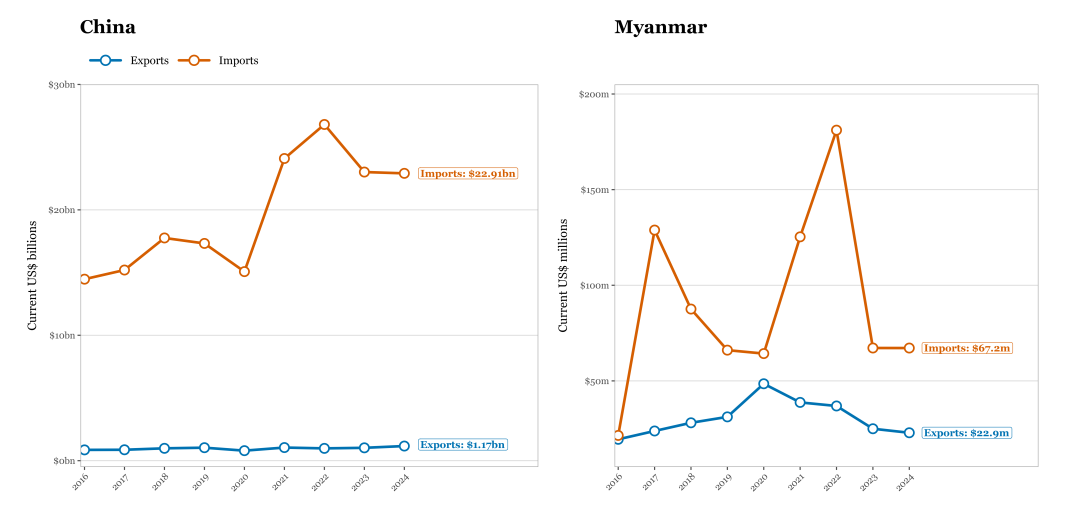
Source: Author’s compilation from ITC Trade Map.
Why China wants the corridor
China’s interest is both economic and strategic. Yunnan is far from China’s principal ports on the eastern seaboard. A connection through Myanmar and Bangladesh could provide southwestern China with another route to the Indian Ocean and improve access to overseas markets.
The strategic value may be even greater. Much of China’s maritime trade passes through the South China Sea and the Strait of Malacca. These routes are commercially efficient, but they also pass through narrow sea lanes and an Indo-Pacific security environment where the United States maintains substantial naval reach and alliance-based influence.
An overland connection towards the Bay of Bengal would give China another transport option. It could reduce, though not eliminate, Beijing’s exposure to disruption along the South China Sea-Malacca route and strengthen China’s economic and strategic presence around the northeastern Indian Ocean.
The corridor would not replace maritime trade. Ocean shipping remains cheaper and can carry far larger volumes than road or rail. Its value to China would lie mainly in strategic redundancy, regional influence and improved access for Yunnan.
That difference matters. The corridor may be strategically more valuable to China than it is commercially valuable to Bangladesh. Dhaka should therefore negotiate on the basis of its own economic interests rather than assume that the benefits will be naturally equal.
Bangladesh needs production, not transit alone
For Bangladesh, the corridor could support port development, logistics services, industrial zones and access to markets in China and Southeast Asia. Chattogram would probably serve as the main maritime gateway, while Mongla could benefit from wider port and inland transport improvements.
The project could also support manufacturing around the Chinese Economic and Industrial Zone in Anwara. Garments, pharmaceuticals, leather products, agro-processing and light engineering could benefit if the corridor genuinely improves access to regional markets.
But transit alone will not transform the economy. A corridor that mainly carries Chinese goods towards Bangladeshi ports may generate tolls, freight charges and warehousing income. Those gains would be useful, but modest compared with the benefits of export growth, local sourcing and industrial upgrading.
Bangladesh should therefore seek clear commitments on local procurement, employment, technology transfer, supplier development and export facilitation. The central question is not simply whether goods will move through Bangladesh. It is whether Bangladeshi firms and workers will capture a meaningful share of the value created.
Myanmar remains the binding constraint
The corridor’s viability depends less on engineering than on political authority. Any practical route would pass through parts of Myanmar affected by armed conflict. Rakhine State is especially important because it provides the most direct connection with Bangladesh. Recent reporting indicates that the Arakan Army controls most of the state, while strategic locations such as Kyaukphyu remain contested.
The risks are already visible. A China-backed power plant in Kyaukphyu, reportedly worth around US$140 million, was dismantled and relocated as fighting approached the area. Conflict changes the economics of infrastructure. It raises construction costs, insurance premiums, security spending and borrowing rates. It also increases the likelihood of delay, damage, closure and contractual failure.
There is a deeper governance problem as well. A transport agreement is only as reliable as the authority capable of enforcing it. Where different organisations control different sections of a route, guarantees issued by the central government may have limited practical value. Any feasibility study must therefore include conflict-adjusted scenarios. It should estimate the consequences of prolonged closures, changes in territorial control, construction delays and traffic volumes falling below forecasts. Bangladesh should be particularly cautious if lenders demand sovereign guarantees. Such guarantees could transfer risks created inside Myanmar to Bangladeshi taxpayers.
The Rohingya issue cannot be separated
The proposed route would pass through the same region from which the Rohingya were displaced.
Chinese representatives have suggested that economic development and connectivity could eventually support stability and repatriation [2]. Economic recovery may help, but infrastructure cannot substitute for citizenship, security, freedom of movement, humanitarian access and protection from persecution.
Bangladesh should not exchange silence on Rohingya rights for promises of roads, railways or investment. Progress on the Rakhine section should be linked to measurable improvements in civilian protection and the conditions necessary for safe, voluntary and sustainable return.
This is not only a humanitarian issue. It is also a commercial one. A corridor through politically unresolved territory cannot offer dependable long-term connectivity.
What Bangladesh should require
Bangladesh should remain engaged, but it should not accept binding financial obligations before the economic case is established.
- An independent feasibility study must first determine whether sufficient freight demand exists. It should compare the proposed corridor with existing sea routes and with infrastructure already under development, including the Bay Terminal, Matarbari, Mongla Port modernisation and domestic railway expansion.
- The project must also create measurable domestic value. Any agreement should contain commitments on Bangladeshi exports, local procurement, employment, skills development, supplier participation and technology transfer.
- Financing arrangements must be transparent. Loan terms, sovereign guarantees, revenue assumptions, procurement procedures and responsibility for cost overruns should be publicly disclosed.
- Bangladesh’s ports and logistics assets should remain open on transparent and non-discriminatory terms. No foreign partner should receive exclusive control over strategically important national infrastructure. Implementation should also be phased. Bangladesh should prioritise investments that remain useful even if the Myanmar connection is delayed. Better ports, domestic railway links, digital customs, coastal shipping, industrial zones and logistics skills would benefit the economy under almost any scenario.
- The World Bank’s assessment of Belt and Road transport corridors supports this cautious approach. Infrastructure produces lasting gains only when it is backed by efficient trade policy, sound institutions, sustainable debt management and appropriate environmental and social safeguards.
Keep the option, avoid the liability
The Bangladesh-China-Myanmar Economic Corridor could eventually strengthen regional connectivity and improve Bangladesh’s position in the Bay of Bengal economy. That possibility should be explored. It should not be confused with present commercial viability. The route remains unsettled. Myanmar’s political authority is fragmented. Key infrastructure is unfinished. Financing terms are unknown. The distribution of benefits has not been demonstrated. Existing trade patterns also suggest that improved connectivity could widen Bangladesh’s deficit with
China unless it is tied to stronger domestic production and export capacity. Bangladesh should therefore keep the corridor option open, negotiate from evidence and invest first in infrastructure that strengthens its own economy. Connectivity is valuable when it expands national capabilities. It becomes a liability when strategic enthusiasm moves faster than commercial evidence.
Sources and Further Reading
- Bangladesh Sangbad Sangstha (2026), ‘China proposes Bangladesh-Myanmar-China economic corridor: PMO spokesman’, 26 June. Available at: https://www.bssnews.net/news-flash/399942
- bdnews24.com (2026), ‘China says Bangladesh-Myanmar economic corridor will remain open to other countries’, 2 July. Available at: https://bdnews24.com/bangladesh/3e560076a4cb
- Hoque, M.S. and Ahamed, A. (2024), ‘Bangladesh-China-India-Myanmar Economic Corridor: An opportunity for regional connectivity and development cooperation in South and Southeast Asia’, Muallim Journal of Social Sciences and Humanities, 8(4), pp. 1-12. Available at: https://doi.org/10.33306/mjssh/292
- International Trade Centre (2026), ITC Trade Map: Trade Statistics for International Business Development. Available at: https://www.trademap.org/ (Accessed: 28 July 2026).
- Islam, S., Wang, W. and Sheng, L. (2022), ‘The construction of Bangladesh-China-India-Myanmar Economic Corridor: Current situation, problem, and countermeasures’, Asian Journal of Social Science Studies, 7(4), pp. 10-24. Available at: https://doi.org/10.20849/ajsss.v7i4.1084
- Karim, M.A. and Islam, F. (2018), ‘Bangladesh-China-India-Myanmar Economic Corridor: Challenges and prospects’, The Korean Journal of Defense Analysis, 30(2), pp. 283-302.
- Pieal, J.N. (2026), ‘Can the China-Myanmar-Bangladesh Economic Corridor become a reality?’, The Daily Star, 1 July. Available at: https://www.thedailystar.net/slow-reads/geopolitical-insights/news/can-the-china-myanmar-bangladesh-economic-corridor-become-reality-4212471
- Rahman, M.H. (2026), ‘The future of the Bangladesh-China-Myanmar Economic Corridor’, The Daily Star, 26 July. Available at: https://www.thedailystar.net/slow-reads/geopolitical-insights/news/the-future-the-bangladesh-china-myanmar-economic-corridor-4232141
- World Bank (2019), Belt and Road Economics: Opportunities and Risks of Transport Corridors. Washington, DC: World Bank. Available at: https://doi.org/10.1596/978-1-4648-1392-4


