
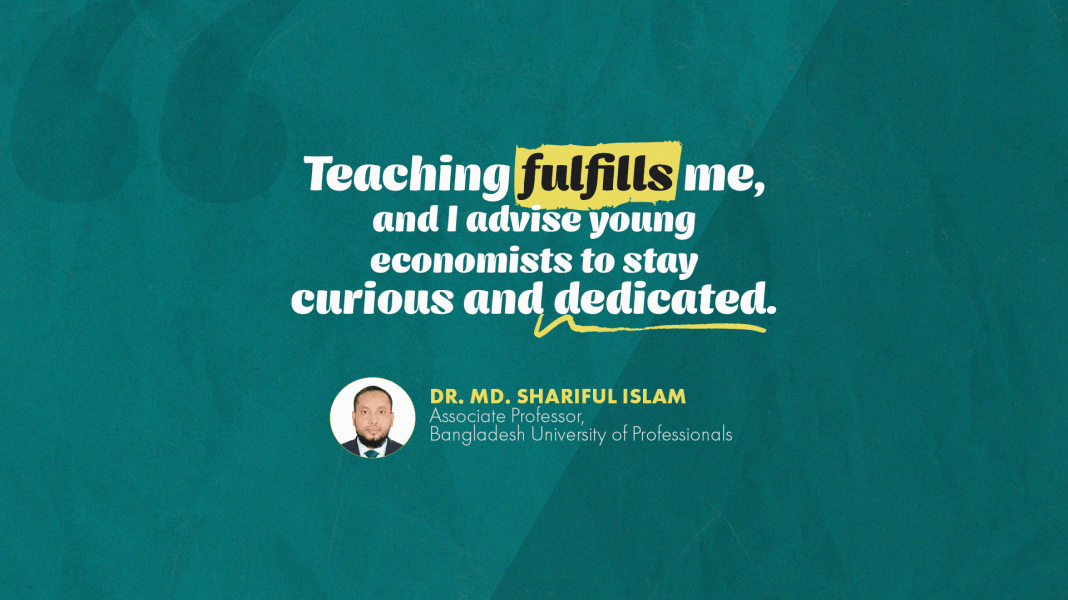
Design: Team Nebula
Dr. Md. Shariful Islam, an Associate Professor in the Department of Economics at Bangladesh University of Professionals, has earned recognition for his academic contributions, including the prestigious MOFCOM Scholarship from the Ministry of Commerce of the People's Republic of China. His extensive research and publications provide valuable insights into global economic issues, particularly in trade, financial development, and sustainable growth.
In this interview, Dr. Islam reflected on his PhD journey in China, sharing key lessons that shaped his academic and professional growth. He expressed a deep passion for teaching. Emphasizing the importance of research and policy, he encouraged aspiring economists to contribute meaningfully. He also discussed major economic challenges, such as trade dependency and financial instability, urging the younger generation to take an active role in driving reforms.
Tahsin Rahman, Salwa Elahi, Samia Nowrin, Rakin Khan & Abid Siddique Emon were in the team to interview him.
What was the initial wow moment with economics that led you to choose it?
Fresh out of high school, I found myself torn between two choices of whether to pursue my bachelor’s in education at Dhaka University or bachelor’s in economics at Jahangirnagar University. Ultimately, I chose economics due to the immense prospect and potential that the field of economics held.
When did you make the decision to become a teacher and researcher? Could you tell us a bit about how your academic career started?
Soon after I started my bachelor’s I discovered my passion for teaching and was determined to become a university teacher and an expert in my field and contribute as much as I could to my field. Throughout my undergraduate and graduate studies, I delved into the world of advanced economics along with rigorous mathematical and econometric techniques, gaining a solid foundation in analytical thinking and methodical problem-solving.
My academic career started at the Asian University of Bangladesh and later I joined as an assistant professor at the Bangladesh University of Professionals (BUP). These years of teaching increased my expertise in the field as while I was teaching, I was also deeply engrossed in empirical research, publishing multiple articles and successfully completing funded research projects focusing on environmental, monetary, and international economics.
We know that you earned your PhD from the University of International Business and Economics in China. Could you share how your journey began and what life was like during your PhD years?
China seemed like the ideal option for where I should pursue my doctoral degree, as its significant achievements in enduring growth, poverty mitigation, and its prominent role in international trade helped establish it as a global economic powerhouse. Hence, I started my journey towards my doctoral degree at the University of International Business and Economics (UIBE) in China.
Adjusting to a new life in a new country was tough as I found myself in numerous academic and personal challenges. But I'm happy to have had those experiences as it helped to grow my as they helped me grow both academically and personally. The curriculum at UIBE significantly advanced my analytical abilities and methodological rigor, particularly in international trade and development economics. Engaging with esteemed professors and peers from around the world exposed me to new and unique economic perspectives. Adapting to a completely new cultural and social environment also strengthened my resilience and adaptability.
What was your experience in China and how it has shaped you?
Living and studying in China was transformative. It profoundly enhanced my personal and professional growth and cultivated cultural appreciation and independence in me, while sharpening my analytical skills through exposure to advanced economic theories and international scholars. This experience ultimately enriched my teaching with a global perspective, significantly impacting my career in Bangladesh University of Professionals.
What are the three most valuable lessons you learned from your PhD journey?
1. Perseverance and Resilience: I learned to stick with things, even when they were tough, which really helped me get through academic challenges. And I also got better at thinking things through, especially when it came to economics, so I could see different sides of an issue.
2. Critical Thinking: I got better at thinking things through, especially when it came to economics, so I could see different sides of an issue.
3. Collaboration and Communication: My ability to communicate properly along with understanding complex ideas clearly and constructively has enriched through effective collaboration with researchers from different backgrounds.
What do you find most fulfilling about being a teacher?
For me, witnessing students intellectual growth and curiosity is the most fulfilling aspect of teaching. It’s incredibly worthwhile to watch students understand complex concepts, apply their knowledge critically, and ultimately develop into thoughtful, skilled professionals who has positive impact on the society.
Which branch of economics do you find most interesting, and why?
Development economics seems particularly more interesting to me because it offers practical solutions to improve lives by addressing economic growth, poverty, justice, and sustainability.
Do you think Bangladesh faces a shortage of young, talented individuals pursuing economics compared to engineering and medical fields, despite its importance as a discipline?
Bangladesh faces a clear shortage of young talent in economics if we compare it to fields like engineering and medicine. This imbalance partly arises from societal perceptions and career incentives. However, economics plays a significant role addressing national challenges like poverty, inequality, and sustainable growth which attract more talented individuals to the field.
What advice would you give to young people in Bangladesh who are interested in pursuing careers in economics or contributing to the country's economic development?
I advise young individuals who are interested in economics to remain curious, stay informed about global and local economic issues, and to continuously develop analytical and quantitative skills. Practical experiences, internships, and research opportunities are invaluable. As we all know Economics is a powerful tool for driving policy changes and development and a firm dedication to this discipline can lead to significant contributions to national prosperity after all.
Looking ahead, what are the biggest challenges for Bangladesh's economy in the next decade, and what advice would you give to young Bangladeshis who want to contribute to the country's economic development?
In my opinion the primary challenges for Bangladesh's economy include unemployment, reducing inequality, adapting to digital transformation, and mitigating climate change impacts. My advice to young Bangladeshis is to equip themselves with relevant skills, to remain adaptable, and to engage proactively in innovative solutions that will enhance economic resilience and sustainability.
Thank you!
Thank you too.
I highly appreciate the initiatives of the Nebula Research Society. Your commitment to encourage critical thinking and curiosity among young researchers is truly commendable. I hope you continue to encourage collaborative research environments and remain passionate and dedicated. Your efforts will undoubtedly cultivate future leaders and change makers, making a meaningful contribution to society. My best wishes!