
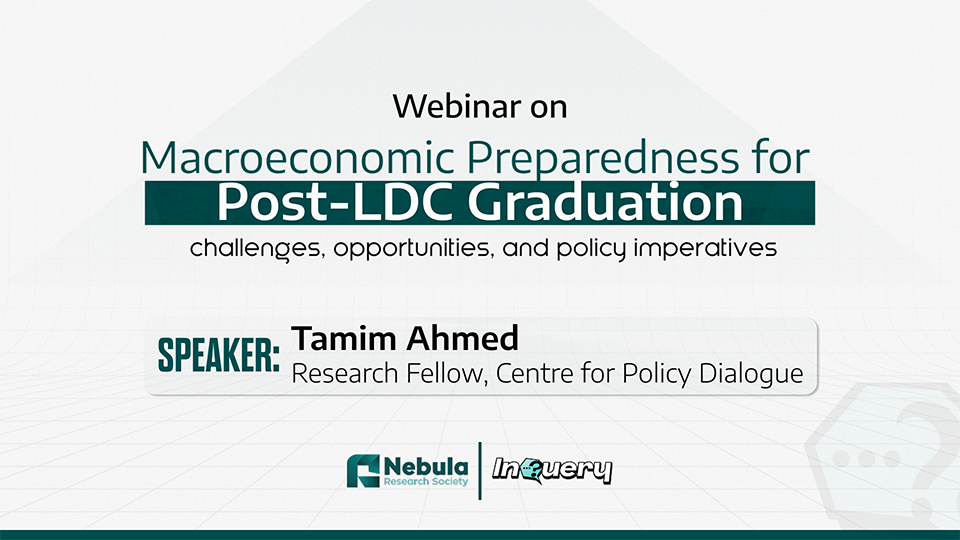
Tamim Ahmed is a Research Fellow at the Centre for Policy Dialogue (CPD) and a distinguished keynote speaker. His research area is economics development, including Fiscal Policy, RMG Dynamics, Labor Rights, Corporate Accountability, and Renewable Energy Investment. In this Inquery session with Nebula Research Society, he discusses Bangladesh’s macroeconomic readiness for LDC graduation.
Key Points
• Met all three LDC criteria, a first
• Three-year transition after graduation
• Inflation, low tax and bad loans
• 80% of exports come from garments
• Use FTAs, FDI and digital finance
Bangladesh’s LDC graduation is a major development milestone. However, given the country’s current macroeconomic challenges, what should be its top three policy priorities for a smooth and sustainable transition?
First, we have been given three more years, and that is a positive thing. Personally, I think graduation is not something to fear, but we always feel we cannot manage it and need more time. It is like postponing an exam: the more it is delayed, the more we feel we need, and often we only tend to prepare for it the night before. The time has been given, but if we do not utilize it properly, we will be trapped in the same loop. The CDP’s own assessment found that Bangladesh is still in a position to graduate.
So, my priorities are these. One, restore macroeconomic stability: bring inflation down, fix the banks and their non-performing loans, and resolve the energy and reserves problem. Two, diversify beyond garments and use trade agreements to open new markets. Three, rebuild investment and revenue, because without roads, energy and a stable environment, investors will not come even if they are interested.
Sir, beyond RMG, which FDI and industrial policy reforms should be prioritized to build technological capacity and attract quality foreign investment?
Garments account for nearly 80 percent of our exports, and that is a structural weakness. If garments falter, the whole economy is at risk. Under the vulnerability index used in LDC graduation, this is one of Bangladesh’s weak points. We need at least three or four more major industries.
We have real potential. I have worked on leather and pharmaceuticals, and we also have plastics, shrimp and agro-food. The second area is trade deals. If we sign free trade agreements, we will not pay tariffs on products going out, and others will not pay on products coming in. Vietnam has already done this with the European Union, but we have not yet signed with our major destinations. These three years are very important for that.
Investment is a problem today. It has fallen to record lows because of political uncertainty and the energy crisis, and an investor who finds no roads and no energy supply will not come, even if interested. Our current fiscal position leaves the government little room to build that infrastructure.
Sir, since you’ve mentioned the low tax-to-GDP ratio, why is it so difficult for the government to improve income tax collection?
In the last fiscal year, tax collection fell to 6.9 percent of GDP. That is among the lowest in South Asia and in the world. The economy is growing, but the government’s revenue is not growing with it.
There are several reasons, and one big one is that roughly three-quarters of our economy is informal. Weak governance over the years and weak banks add to the problem. The result is that government income cannot even cover its operating costs. In 2024–25, government income was Tk 4,41,817 crore against operating expenditure of Tk 4,61,743 crore, so the government cannot do development work from its own money. Interest payments are already heavy, and the way we borrow will increase them further.
Sir, how can digitalization help bring the informal sector into the tax net?
Digital finance is one of our biggest success stories. Over the last decade or so, Bangladesh has gone through a major transformation in digital finance. This is a strength we can use to bring informal activity into the formal economy, and with it into the tax system. Every challenge also brings an opportunity, and this is one of them.
Sir, how might an increase in the government pay scale affect the overall economy, particularly inflation and government expenditure?
Government salaries are part of operating expenditure, so any increase adds to a budget that is already stretched. In the previous regime, there was pressure for mega and expensive projects, and for pay increases. This created fiscal pressure, banks were burdened, and the government needed large amounts of money. Sometimes money was printed and large loans were taken from Bangladesh Bank and from private banks, and that is one reason inflation is high today.
There is also a demand for public sector jobs, because private sector jobs have not been created enough, which makes government pay and security even more important to young people.
What the Speaker Covered
Graduation
• All three LDC criteria met, a first for any country
• Delayed after COVID-era request and political turmoil
• Three-year transition period follows graduation
Benefits at risk
• Duty-free export access (India pays about 12% to Europe)
• Pharma patent flexibility for cheap local drugs
• Concessional, low-interest financing
• Risk: less urgency to become competitive
Challenges
• Inflation: import dependence, weaker taka, money printing, weak market monitoring, flood shocks
• Tax at 6.9% of GDP; about 75% of economy informal
• Revenue no longer covers operating costs; interest squeezes development
• About 1 in 3 loans non-performing; depositor trust at risk
• About 80% of exports are garments
• Youth unemployment about 12% vs 5–6% nationally
• Investment at record low: politics, energy, infrastructure
• Higher policy rate fights inflation but raises borrowing cost
Way forward
• Use the three-year window to prepare
• Grow leather, pharma, plastics, shrimp, agro-food
• Sign FTAs and attract FDI
• Use digital finance to formalise informal business
• Fix banks, energy and inflation; develop gas sources


