
Copyright: Nebula Research Society
For decades, a simple theory dominated development economics. Poor countries become rich by industrialization. Factories move from rich countries to poorer ones where wages are lower. Workers move from farms to factories. Productivity rises, incomes grow, and the country climbs the development ladder.
It worked spectacularly well in parts of East Asia. In 1960 South Korea’s GDP per capita was about $1,600 (PPP), roughly comparable to many African countries at the time. By 2022 it exceeded $44,000. Manufacturing exports drove much of that transformation. Electronics, automobiles, and shipbuilding turned a once poor economy into a technological powerhouse. China repeated the model at an even larger scale. In 1990 China produced less than 3% of global manufacturing output. Today it produces roughly 30%, more than the United States, Germany and Japan combined. Hundreds of millions of workers moved from agriculture into factories. The result was the largest poverty reduction in human history. But something unusual has been happening in the global economy over the past two decades.
Industrialization, once the standard path to prosperity, is becoming harder. Economists sometimes call this phenomenon “premature deindustrialization.” In many developing countries, manufacturing employment peaks at much lower income levels than it once did.
In the United States and Britain, manufacturing employment began to decline only after incomes reached high levels. In contrast, countries such as Brazil, South Africa, and India have seen manufacturing employment stagnate while their economies are still relatively poor.
The numbers illustrate the shift. In many successful industrializers, manufacturing employment once accounted for 25–30% of the workforce. Today many developing economies struggle to reach 15%.
Why is this happening? Part of the explanation is technology. Modern factories are far more automated than those of the past. A car plant today produces more vehicles with far fewer workers than in the 1970s. Even when manufacturing expands, it often creates fewer jobs.
Another factor is the dominance of global manufacturing hubs. China built enormous industrial ecosystems over four decades. Supply chains, skilled workers, logistics networks and specialized suppliers cluster together in ways that are difficult for new entrants to replicate.
When a smartphone factory opens in China or Vietnam, it can source components from hundreds of nearby firms. Replicating that network elsewhere requires years of investment and coordination.
Trade patterns have also shifted. Many multinational companies now prefer to concentrate production in a few large hubs rather than distribute factories widely across many countries. This leaves some developing economies in an awkward position. They must grow richer without passing through the same labor-intensive industrial stage that earlier success stories experienced.
Some countries are experimenting with alternatives. Services exports, particularly digital services, have expanded rapidly in places like India and the Philippines. Tourism has become a major growth engine for others. Yet these sectors rarely absorb labor on the scale that manufacturing once did.
This raises an important question for political economy. If the traditional path of mass industrial employment is narrowing, what replaces it?
Governments are beginning to experiment with new forms of industrial policy. Countries such as Vietnam, Mexico and Bangladesh are still attracting labor-intensive manufacturing by integrating deeply into global supply chains. Meanwhile others are focusing on logistics, renewable energy production, or specialized technology niches.
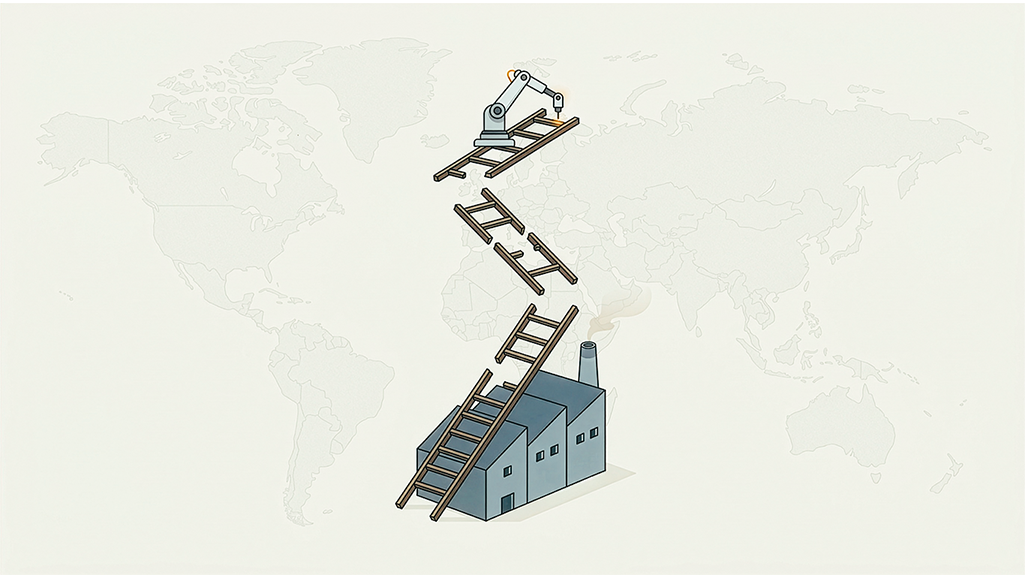
Economic development has never followed a perfectly predictable script. But the global economy may now be entering a phase where the old playbook of industrialization becomes harder to replicate. For much of the twentieth century, cheap manufacturing was the ladder that lifted countries into prosperity. In the twenty-first century, that ladder may be getting shorter.