
illustration: S M Walid Bin Wahid Sifat, Nebula Research Society
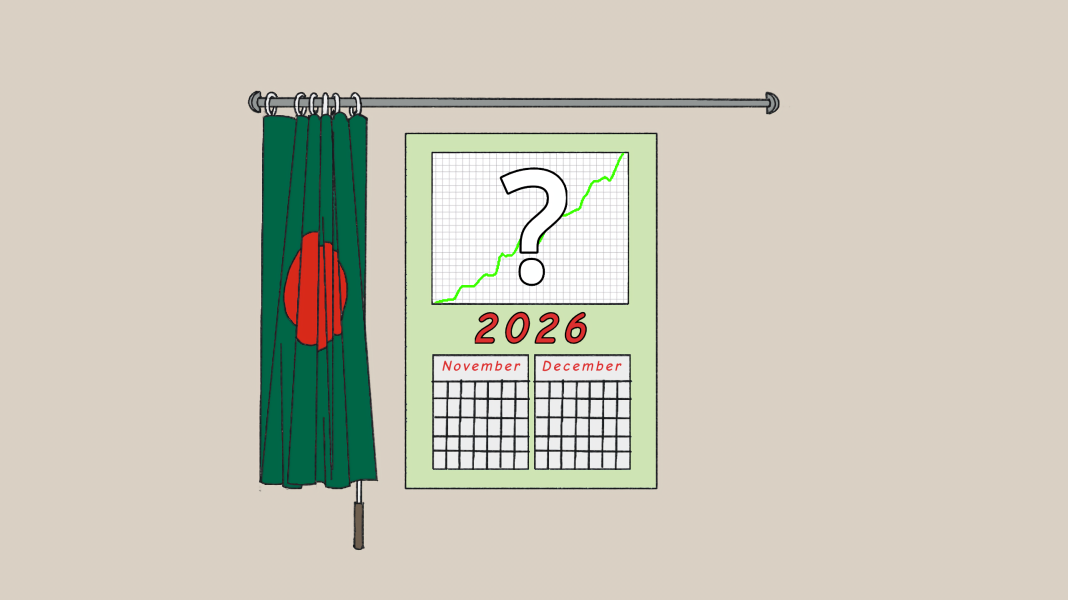
November 2026. Save the date. That is when Bangladesh officially graduates from its status as a Least Developed Country (LDC). You may be scrolling through headlines in the news, sipping a cup of tea, and questioning why this date matters. Is this a pride for us?
It's a consequence of our economic progress and advancement, a testament to Bangladesh's resilience and perseverance. But this victory comes with a further paradox: the very success that compels us to go forward also removes the security blanket of international support arrangements—concessions we've assumed all along. We're departing the peaceful current and entering the open sea, and the question is: Are our sails truly equipped for the self-reliant journey?
What Does LDC Graduation Mean for Bangladesh?
The LDC status has provided Bangladesh with essential lifelines, including preferential access to markets, concessionary loans, and special flexibilities for sectors such as pharmaceuticals, for over 50 years. It was a worldwide recognition of vulnerability coupled with a guarantee of support.
Bangladesh has way exceeded the graduation threshold of economic strength, human development, and reduced economic vulnerability. Our Gross National Income (GNI) per capita of US$2,684 in October 2024 is comfortably higher than the US$1,306 threshold. Our reading of the Human Assets Index (HAI) at 75.3 points comfortably eclipses the 66-point threshold. It is an unquestioned success story, showcasing our "V-shaped recovery" even in a period of global turmoil.
Can Our RMG Stay at a Standstill Amidst the Storm?
Always wondering what is behind Bangladesh's steady rise in foreign exchange reserves? A significant portion of this is attributed to our Ready-Made Garment (RMG) industry. The industry is of a survival nature, accounting for over 80% of total export earnings, employing approximately 4 million people, and contributing around 10% to our annual GDP. And our biggest export market? None other than the United States and the European Union.
For decades, the EU's Everything But Arms (EBA) initiative has given our apparel duty-free and quota-free entry. It was a competitive tool. Once you graduate, this support will no longer be available. Analysts estimate tariffs at an average of 9.3% in the EU once the graduation period is over, with some studies suggesting an average increase of 12% on apparel. That isn't a hypothetical number; that's estimated yearly export losses of $6 billion to $8 billion. Consider that blow to our economy.
The conditions demand an immediate change. We can no longer compete on tastes; our competitiveness must be built on efficiency. Competing for the GSP+ privilege of the EU is the very essence of hope, but it requires adherence to 27 to 32 international treaties on human rights, labour standards, and environmental protection. Are we capable of meeting this challenge? Are our labour laws truly equipped to meet the test of international scrutiny?
The Patent Paradox: Cheap Drugs and the Future of Innovation
Let us consider our pharmaceutical industry—a local success story that has made affordable, life-saving drugs accessible to every corner of the world. As an LDC, Bangladesh was granted a special WTO waiver, allowing it to manufacture generic medicines without implementing patents on most medicines. This "patent-free regime" expires in November 2026.
What does it mean? More costly medicines for our people? A restriction on the ability of our generic industry to rapidly develop cheaper duplicates of recently patented drugs? While there is some leeway in the Bangladesh Patent Act (BPA) 2023, the industry will have to operate in a tighter regulatory environment, necessitating robust legal and judicial capabilities to respond to the threat of increased patent litigation. The trick is to harmonize the incentive for innovation with the assurance of continued public access to essential medicines.
Unlocking Bangladesh's Financial Future Beyond Traditional Aid
Bangladesh relied on concessional finance—cheap loans and grants—for its vital development programs for years. This LDC-only source of funding will mainly flip a switch off. It is particularly a cause for concern for a nation highly vulnerable to climate change.
Bangladesh has accessed special climate funds like the Green Climate Fund (GCF), receiving approximately 33% of global concessional climate finance (a three-year average of USD 21 billion between 2019 and 2022). Loss of access to these streams is a severe blow to a country that is perpetually fighting sea level rise and severe weather events. The funding climate will be "market-dependent" instead of "aid-dependent," which translates to higher-cost interest rates and more stringent repayment terms. Could this lead to a "climate debt trap" if we're forced to borrow to pay for essential adaptation?
While improved post-graduation credit ratings are likely to boost foreign direct investment (FDI), we must proactively diversify our sources of funding and strengthen our public financial management to recapture lost aid.
The Unspoken Truth: Are Bangladesh's Foundations Ready for the Post-LDC Quake?
Graduation is not just a matter of losing external advantages; it also highlights our own internal economic and structural vulnerabilities. Our logistics costs, for instance, are nearly one-fifth of our export costs—double the rate of most of our competitors—due to congested roads, slow clearance, and inadequate port facilities.
When companies face these inefficiencies, their expenses increase, and their competitive advantage decreases.
The regulations that need to be met are becoming increasingly stringent. Nowadays, international consumers are demanding greater transparency and traceability in supply chains, which affects both the safety and rights of people working in them. Are we ready to invest in proper systems and well-trained personnel to meet these higher requirements?
Only in December 2024 did 3.8% of people living in rural communities use computers, compared to 20.7% of those in urban areas. This significant gap in the digital world prevents some individuals from participating, which may exacerbate existing inequalities. Because we live in an advanced digital world, is it still right to leave most people out by not including them?
Furthermore, heightened instability in the macroeconomic sphere persists. Slowly but surely, inflation is taking away people's purchasing power as it hovers near 9%. From FY21 to October 2024, the amount of foreign exchange reserves has shrunk from US$46.39 billion to US$25.49 billion. The Taka has depreciated by almost 25% between FY21 and FY23 and by an additional 25% by August 2024. The banking sector is burdened by a "significant accumulation of non-performing loans (NPLs)." The loss of external support could exacerbate these internal frailties.
Finally, our Cottage, Micro, Small, and Medium-Sized Enterprises (CMSMEs), on which employment and GDP depend, are particularly vulnerable. They are often lacking in capacity, infrastructure, and funds and, hence, are highly susceptible to post-graduation interruptions. Will our Smooth Transition Strategy (STS) serve their needs, or will it become a paper tiger?
The Roadmap to Resilience: Bangladesh's Bold Moves for a Post-LDC Future
So, what then? While others call for graduation to be delayed (some even by 10-12 years), labelling Bangladesh as "unprepared," the caretaker government still clings to the November 2026 date. It leaves us with no option but an active and strategic one.
The system should move away from simple likes and focus on serious, goal-oriented competition. For this reason, health education should include:
- Developing Powerful Negotiations: Improving trade negotiation skills, updating IP offices and setting up rapid commercial courts.
- Training and Skills: Increasing the knowledge base of individuals and creating a team that can work flexibly and efficiently.
- Enhancing Technology: Providing digital support, utilizing advanced equipment, and bridging the gap in technology knowledge.
- Updating Governance: Efforts to make the data more transparent, maintain consistency, and address the issue of Non-Performing Loans in the banking sector.
For a long time, Professor Mustafizur Rahman has emphasized that relying too heavily on a single tourist spot makes Bangladesh more vulnerable to economic fluctuations. It calls for finding additional export markets and offering goods such as pharmaceuticals, ICT, and food products in addition to garments. This encompasses exploring new markets beyond the EU and US, as well as diversifying our export basket beyond garments to include pharmaceuticals, ICT, and agro-processing.
The extended duty-free preference under the EBA, which lasts until 2029, is a brief window. Rather than waiting passively, let's treat this as an opportunity to improve trading processes, implement reforms, and make businesses more efficient.
All these ideas—about diversifying markets and exports, always the experts' go-to recommendations—are now not just suggestions but imperative requirements. It's somewhat amusing how quickly we can react when there's a fire, even if perhaps it would have been easier to check the smoke detectors a bit earlier.
References
- Asian Development Bank Institute (ADBI). (2025, May). Preparing for LDC graduation: Sustaining development and integration amid changing trade schemes. https://www.asiapathways-adbi.org/2025/05/preparing-for-ldc-graduation-sustaining-development-and-integration-amid-changing-trade-schemes/
- Bekkers, E., & Cariola, G. (2025). The impact of LDC graduation on trade: A quantitative assessment. The Journal of International Trade & Economic Development. https://repository.graduateinstitute.ch/record/302627
- Climate Policy Initiative (CPI). (2024, October). Understanding global concessional climate finance 2024. https://www.climatepolicyinitiative.org/wp-content/uploads/2024/10/Understanding-Global-Concessional-Climate-Finance-2024.pdf
- Economic Relations Division (ERD), Ministry of Finance, Government of Bangladesh. (n.d.). Outcome Document 1. http://erd.portal.gov.bd/sites/default/files/files/erd.portal.gov.bd/page/6fc21888_1122_4f28_b548_75c698b5b78e/Outcome%20Document%201.pdf
- Friedrich-Ebert-Stiftung (FES) Bangladesh. (n.d.). Challenges and opportunities for SMEs in Bangladesh associated with LDC graduation. Retrieved from https://library.fes.de/pdf-files/bueros/bangladesch/22062.pdf
- Gateway House. (n.d.). Least developed to developing. Retrieved from https://www.gatewayhouse.in/least-developed-to-developing/
- General Economics Division (GED) of Bangladesh Planning Commission. (2021). Impact assessment and coping up strategies of graduation from LDC status for Bangladesh. https://gedkp.gov.bd/wp-content/uploads/2021/02/LDC-Study-Report.pdf
- Institute of South Asian Studies (ISAS), National University of Singapore. (n.d.). Bangladesh's graduation: Challenges and imperatives to continued international support measures. Retrieved from https://www.isas.nus.edu.sg/papers/bangladeshs-graduation-challenges-and-imperatives-to-continued-international-support-measures/
- RAPID Bangladesh. (2024, November 30). Bangladesh's impending LDC graduation: Implications for the pharmaceutical sector (Policy Brief). https://www.rapidbd.org/wp-content/uploads/2024/12/Final_Policy-Brief-LDC-Graduation-Impact-on-Pharmaceutical_30Nov2024.pdf
- Razzaque, M., et al. (2024, September). Bangladesh's impending LDC graduation: Implications for the RMG sector(Policy Brief). The International Growth Centre. https://www.theigc.org/sites/default/files/2024-09/Razzaque%20et%20al.%20Policy%20Brief%20September%202024.pdf
- Star Business Report. (2025, February 10). IPPS for deferring LDC graduation by 10-12 years. The Daily Star. https://www.thedailystar.net/business/news/ipps-deferring-ldc-graduation-10-12-years-3820096
- Syam, N., & Syed, S. (2023). Impacts of LDC graduation on Trade-Related Aspects of Intellectual Property Rights (TRIPS) in Cambodia, Djibouti, Senegal and Zambia. United Nations Department of Economic and Social Affairs. https://www.un.org/development/desa/dpad/publication/impacts-of-ldc-graduation-on-trade-related-aspects-of-intellectual-property-rights-trips-in-cambodia-djibouti-senegal-and-zambia/
- The Business Standard. (2024, May 13). How Bangladesh struggles to secure WTO trade benefits ahead of LDC graduation. The Business Standard. https://www.tbsnews.net/economy/how-bangladesh-struggles-secure-wto-trade-benefits-ahead-ldc-graduation-1115426
- The Daily Star. (2023, February 13). Overcoming challenges of LDC graduation. The Daily Star. https://www.thedailystar.net/supplements/32nd-anniversary/towards-smart-bangladesh/news/overcoming-challenges-ldc-graduation-3244706
- The Daily Star. (2024, April 20). Bangladesh must prepare for post-LDC challenges. The Daily Star. https://www.thedailystar.net/business/economy/news/bangladesh-must-prepare-post-ldc-challenges-3855091
- The Daily Star. (2024, February 17). Are we prepared to seize the new global opportunities? The Daily Star. https://www.thedailystar.net/opinion/views/news/are-we-prepared-seize-the-new-global-opportunities-3824791
- The Daily Star. (2024, May 10). How will LDC graduation impact Bangladesh's RMG sector? The Daily Star. https://www.thedailystar.net/opinion/views/news/how-will-ldc-graduation-impact-bangladeshs-rmg-sector-3870356
- The Daily Star. (2024, May 13). Post-LDC challenges and the future of Bangladesh's exports. The Daily Star. https://www.thedailystar.net/opinion/views/news/post-ldc-challenges-and-the-future-bangladeshs-exports-3873126
- The Daily Star. (2024, May 20). Unprepared LDC graduation to bring more problems. The Daily Star. https://www.thedailystar.net/business/news/unprepared-ldc-graduation-bring-more-problems-3878851
- The Financial Express. (2024, February 7). Devising strategy for IP in post-LDC era. The Financial Express. https://today.thefinancialexpress.com.bd/editorial/devising-strategy-for-ip-in-post-ldc-era-1739024882
- The Financial Express. (2024, May 13). No pulling back on LDC graduation. The Financial Express. https://today.thefinancialexpress.com.bd/editorial/no-pulling-back-on-ldc-graduation-1744900245
- The Observer. (2024, December 1). Unprepared LDC graduation to bring more problems. The Observer. https://www.observerbd.com/news/513133
- Third World Network. (2013, June 15). LDC TRIPS exemption approved with mixed reactions. TWN Info Service on Intellectual Property Issues. https://twn.my/title2/intellectual_property/info.service/2013/ipr.info.130606.htm
- Tribune Editorial. (2025, March 18). LDC graduation challenges cannot be ignored. Dhaka Tribune. https://www.dhakatribune.com/opinion/editorial/376576/ldc-graduation-challenges-cannot-be-ignored
- UN Committee for Development Policy (UNCDP). (2024, October). Bangladesh's LDC Graduation: Current Status and Transition Challenges. https://www.un.org/development/desa/dpad/wp-content/uploads/sites/45/CDP-PL-2025-BGD-transition.pdf
- United Nations. (n.d.). Quick facts: Least developed countries. Retrieved from https://www.un.org/en/conf/ldc/quick_facts.html
- United Nations LDC Portal. (n.d.). Bangladesh graduation status. Retrieved from https://www.un.org/ldcportal/content/bangladesh-graduation-status
- WTO Secretariat and EIF. (2022). Trade impacts of LDC graduation - Matters related to the WTO agreements. https://www.un.org/ldcportal/sites/www.un.org.ldcportal/files/files/documents/2022/Sep/trade_impacts-cambodia_2022.pdf